
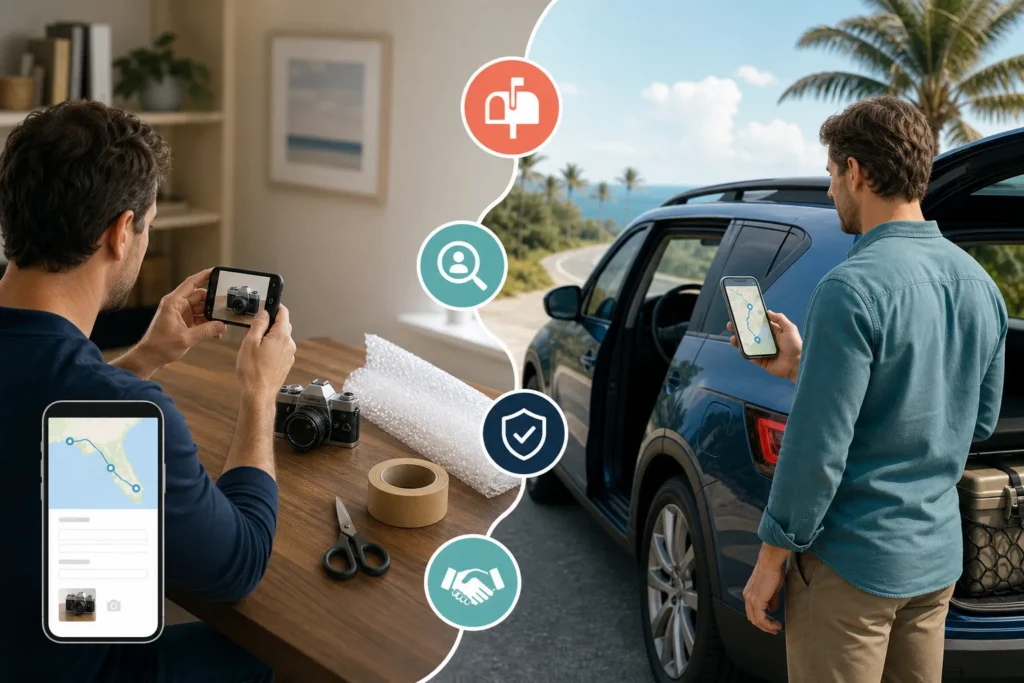
Think the model may fit your item or trip?
If you have a permitted item or an existing Florida driving route, you can create an account and review the process before committing.
Peer-to-peer delivery, sometimes called crowdshipping, matches someone who needs an item moved with a traveler already making a compatible trip. The sender describes the item and route, the traveler reviews the opportunity, and the platform coordinates payment information and handoff confirmation.
For PackItPal, this means ground delivery within Florida—not air travel, international luggage delivery or a conventional courier fleet. It can suit an ordinary, lawful and inspectable item when timing is flexible and everyone can coordinate the handoffs. Another option may be better when you need guaranteed timing, carrier-scale tracking, included protection or specialized handling.
What is peer-to-peer delivery?
In an existing-trip peer-to-peer model, the platform does not automatically dispatch a dedicated delivery vehicle. Instead, it helps match a delivery request with someone whose planned route, date, vehicle capacity and availability are compatible.
The usual participants are:
- Sender: Describes the item, route, timing and value and prepares it for safe transport.
- Traveler: Reviews the request, inspects the item and carries it on a compatible trip in return for an agreed reward.
- Recipient: Receives the item and participates in the physical delivery confirmation.
- Platform: Coordinates account information, matching, payment status and transaction records.
Peer-to-peer delivery is not one standardized service category. Some platforms focus on trips that were already planned, while others operate more like networks of independent local delivery drivers. PackItPal’s published model focuses on visible, permitted items and verified people already driving compatible routes within Florida.
Sources: Crowdshipping in last mile deliveries: Operational challenges and research opportunities – ScienceDirect; How Peer-to-Peer Delivery Works – Pack it Pal; PackItPal Terms of Service – Pack it Pal; Using the 'Crowd' to Deliver Packages
How a PackItPal delivery works, step by step
- The sender posts the request. The listing identifies the Florida origin and destination, date, item size, value and an accurate description of the visible contents.
- A traveler identifies a compatible trip. A useful match must account for more than general direction. Timing, precise locations, available vehicle space and handoff availability also matter.
- Both parties review the match. They consider profiles, the route, item requirements and the proposed reward before agreeing to proceed. Posting does not guarantee that a compatible traveler will be available.
- The traveler inspects the item. At pickup, the physical contents should be open and visible. The traveler can reject an item that is different from its listing, prohibited, unsafe or otherwise unacceptable.
- The parties document custody and package the item. They record condition and handoff evidence. Secure packaging or an optional seal can be applied after inspection—not before it in a way that hides the contents.
- The recipient confirms physical delivery. PackItPal uses a one-time handoff code that should be used only after the item reaches the correct recipient. Checkout, custody, delivery confirmation and payout eligibility are separate transaction stages.
Beginners should not treat payment as proof that delivery has occurred or assume that the traveler receives the reward immediately. The public terms do not provide a precise payout timetable.
Sources: How Peer-to-Peer Delivery Works – Pack it Pal; PackItPal Terms of Service – Pack it Pal; PackItPal Safety – Pack it Pal; Pack it Pal – Send for less. Earn on trips already happening.
What senders are responsible for
A sender is not simply buying spare trunk space. The traveler needs enough accurate information to decide whether accepting custody is appropriate.
- Describe the item, size, value, route and timing accurately.
- Disclose fragility, batteries and other characteristics that may affect eligibility or handling.
- Allow the traveler to inspect the actual contents before custody begins.
- Use packaging suitable for ordinary movement inside a vehicle after inspection.
- Set realistic pickup and delivery expectations.
- Make sure the recipient can attend the destination handoff.
- Preserve listing, condition and custody records.
- Use the platform’s payment, messaging and confirmation process instead of undocumented arrangements.
- Review current cancellation, dispute and item-protection terms before committing.
Packaging deserves particular attention. Poor packaging can undermine damage claims with conventional carriers, and PackItPal does not promise carrier-style protection by default. Photographs and handoff records are useful evidence, but they are not the same as insurance or a guarantee of reimbursement.
Sources: PackItPal Terms of Service – Pack it Pal; PackItPal Safety – Pack it Pal; FedEx Declared Value & Limits of Liability for Shipments | FedEx
What travelers are responsible for
Travelers take custody of another person’s property and should evaluate the full responsibility—not just the available vehicle space or displayed reward.
- Confirm that the delivery fits the planned Florida route and schedule.
- Review the item description, dimensions, value and both handoff locations.
- Inspect the contents and reject anything unknown, inconsistent, unsafe or prohibited.
- Make sure the item can be secured without obstructing visibility, movement or safe driving.
- Record condition and custody as required.
- Protect the item from foreseeable movement, weather and theft.
- Communicate delays or problems through the platform.
- Deliver only through the correct physical handoff process.
- Never request or use the delivery code before delivery is complete.
Insurance: Before accepting paid deliveries, travelers should ask their insurer or agent whether the specific use is covered. Florida consumer guidance warns that personal auto policies typically do not cover business use, but the answer depends on the policy and insurer. Do not assume that either a personal policy or the marketplace automatically supplies delivery-related coverage.
Taxes: Delivery rewards may be taxable gig-economy income. The IRS says gig income must be reported even when it is part-time or no information return is received. Travelers should retain income and expense records and seek individual tax advice when needed.
Sources: PackItPal Safety – Pack it Pal; Florida Department of Financial Services; Gig economy tax center | Internal Revenue Service
What kinds of items may fit the model?
PackItPal identifies clothing, books, ordinary accessories and non-hazardous household items as examples of generally eligible goods. Every item still depends on accurate description, inspection, packaging and applicable platform limits.
Manual review may be required for electronics, batteries, fragile items, food and unusually valuable goods. Manual review is not automatic approval, and the public materials do not state every approval criterion.
PackItPal prohibits categories including weapons, illegal drugs, cash, passports and other identity documents, alcohol, aerosols, prescription medicines, hazardous materials, stolen goods, and sealed or unidentified contents.
A platform prohibition does not necessarily mean an item is illegal to transport under every circumstance. Conventional carriers may accept some regulated items under specific eligibility, packaging, labeling and transport rules. PackItPal may apply a narrower policy. If the platform prohibits an item, do not negotiate a private exception with a traveler; use a lawful carrier or specialist equipped to handle it, if one exists.
Sources: PackItPal Safety – Pack it Pal; What Can Someone Deliver for You? – Pack it Pal; Shipping Restrictions & HAZMAT – What Can You Send in the Mail? | USPS
Potential benefits—and why they are not automatic
- Use of an existing trip: The model can use carrying capacity on a journey that was already planned. That advantage weakens when pickup and delivery require a large detour or a separate trip.
- Potential affordability: A compatible route may cost less in some circumstances. Compare the complete marketplace price with alternatives, including fees, packaging, travel to handoff locations and differences in protection. There is no basis for claiming that every request will be cheaper.
- Direct coordination: The parties can review a specific item, route and handoff. The trade-off is that both endpoints must be responsive and available.
- A traveler reward: A traveler may earn from a planned journey. The gross reward should be weighed against detour distance, waiting time, vehicle expenses, insurance implications and taxes.
- Possible environmental efficiency: Using an existing trip with a small detour may reduce dedicated delivery mileage. It is not inherently green: research has found worse outcomes when participants make dedicated parcel trips.
The model has its strongest practical and environmental case when the journey was already happening and the delivery adds little extra driving.
Sources: Crowdshipping in last mile deliveries: Operational challenges and research opportunities – ScienceDirect; Shipping outside the box. Environmental impact and stakeholder analysis of a crowd logistics platform in Belgium – ScienceDirect; Crowdshipping for sustainable urban logistics: A systematic review of the literature – ScienceDirect
When a carrier, courier or specialist may be better
Peer-to-peer delivery is one option, not a replacement for every delivery service.
| Need | Peer-to-peer existing-trip delivery | Potentially better alternative |
|---|---|---|
| Flexible delivery of an ordinary item | May fit when a traveler already has a compatible route | Compare with a standard parcel service |
| Guaranteed or operationally critical deadline | Matching and timing depend on traveler availability and plans | Time-defined carrier service or dedicated courier |
| National scan-based tracking | Uses platform status, custody evidence and handoff confirmation | Parcel carrier with network scans and tracking |
| Included or optional shipment protection | PackItPal says protection is absent unless expressly activated at checkout | Carrier or provider offering suitable coverage under stated terms |
| Regulated, refrigerated or oversized goods | May be prohibited or unsuitable for a passenger vehicle | Authorized specialty or freight provider |
| No in-person handoff availability | Both endpoints require workable coordination | Door-to-door or hold-at-location carrier service |
Another service is also likely to be preferable for irreplaceable objects, unusually valuable goods, temperature-controlled medical items, commercial freight or anything requiring a formal chain of custody. If no compatible traveler exists for the route and date, the marketplace cannot create the underlying trip.
Sources: How Peer-to-Peer Delivery Works – Pack it Pal; Crowdshipping for sustainable urban logistics: A systematic review of the literature – ScienceDirect; UPS Service Guarantee | UPS – United States; Tracking Support | UPS – United States; Ground Advantage | USPS; Same Day Delivery Across the U.S. | FedEx
Verification, evidence and protection are different things
Several platform controls can sound similar but serve different purposes:
- Identity review helps connect an account with submitted identity information. It does not guarantee honesty, reliability or successful delivery.
- Item inspection lets the traveler compare visible contents with the listing and reject a discrepancy.
- Condition and custody evidence records what the parties observed and when possession changed.
- Delivery confirmation records completion of the physical destination handoff.
- Item protection or insurance concerns financial coverage under specific policy terms.
These controls are not interchangeable. PackItPal’s current terms say item protection is not included unless checkout expressly identifies an active policy and links to its coverage terms. Do not infer reimbursement rights from verification, photographs, payment status or a handoff code. Review the terms displayed for the actual transaction before proceeding.
Sources: PackItPal Terms of Service – Pack it Pal; PackItPal Safety – Pack it Pal; Pack it Pal – Send for less. Earn on trips already happening.
A quick suitability checklist
Peer-to-peer delivery may be a reasonable fit for a sender when:
- The item is ordinary, permitted and suitable for a normal passenger vehicle.
- The sender can describe it accurately and allow complete inspection.
- The delivery date has enough flexibility for route matching.
- The sender and recipient can coordinate physical handoffs.
- The available tracking, protection and dispute terms are acceptable.
It may be a reasonable fit for a traveler when:
- The trip was already planned and the detour is modest.
- The exact item can be inspected before custody.
- The item can be carried securely without affecting safe driving.
- The reward makes sense after time, mileage and other costs.
- Insurance and tax implications have been considered.
Consider another option when:
- A firm deadline carries significant consequences.
- The item cannot be opened for inspection.
- The contents are prohibited, regulated or require specialist handling.
- The item is irreplaceable or its value exceeds your risk tolerance.
- Carrier-scale scans, signature options or stated protection are essential.
- Either endpoint cannot reliably attend the handoff.
The right question is not whether peer-to-peer delivery is universally better. It is whether a specific item, route, date and level of risk fit an existing-trip marketplace.
Sources: How Peer-to-Peer Delivery Works – Pack it Pal; PackItPal Terms of Service – Pack it Pal; PackItPal Safety – Pack it Pal; What Can Someone Deliver for You? – Pack it Pal; Florida Department of Financial Services; Gig economy tax center | Internal Revenue Service
Frequently asked questions
Is peer-to-peer delivery the same as courier delivery?
No. An existing-trip marketplace matches an item with a traveler already taking a compatible route. A dedicated courier is generally dispatched to complete the delivery. Some services described as crowdsourced delivery operate closer to the courier model, so platform rules matter.
Can the traveler inspect my item?
Yes. PackItPal requires the contents to be visible for inspection before the traveler accepts custody. The traveler may reject an item that does not match the listing or appears prohibited or unsafe.
Should I seal the item before pickup?
Do not conceal the contents in a sealed package before inspection. The item can be securely packaged and optionally sealed after the traveler has inspected it and the parties have documented its condition.
Does posting a request guarantee a match or delivery date?
No. A match depends on traveler availability, route compatibility, timing, vehicle capacity and handoff arrangements. Posting or paying does not by itself guarantee delivery by a preferred date.
Is my item insured or protected?
Do not assume it is. PackItPal says item protection is not included unless checkout expressly shows an active policy and links to its coverage terms. Verification and handoff evidence are not substitutes for insurance.
When does the traveler receive the reward?
Payment, physical delivery and payout eligibility are separate stages. The public terms do not provide a precise payout timetable, so travelers should review the current transaction terms rather than assume immediate payment.
Can a traveler reject an item at pickup?
Yes. A traveler can reject an item that differs from its description or appears unknown, prohibited, unsafe or unsuitable for the vehicle.
Are traveler rewards taxable?
They may be taxable gig-economy income. The IRS says gig income must be reported even when it is part-time or not shown on an information return. Keep income and expense records and seek tax advice for your circumstances.
Research sources
- Crowdshipping in last mile deliveries: Operational challenges and research opportunities – ScienceDirect
- How Peer-to-Peer Delivery Works – Pack it Pal
- Shipping outside the box. Environmental impact and stakeholder analysis of a crowd logistics platform in Belgium – ScienceDirect
- PackItPal Terms of Service – Pack it Pal
- PackItPal Safety – Pack it Pal
- Pack it Pal – Send for less. Earn on trips already happening.
- Using the 'Crowd' to Deliver Packages
- Join PackItPal – Pack it Pal
- What Can Someone Deliver for You? – Pack it Pal
- Shipping Restrictions & HAZMAT – What Can You Send in the Mail? | USPS
- FedEx Declared Value & Limits of Liability for Shipments | FedEx
- Florida Department of Financial Services
- Statutes & Constitution :View Statutes : Online Sunshine
- Gig economy tax center | Internal Revenue Service
- Crowdshipping for sustainable urban logistics: A systematic review of the literature – ScienceDirect
- UPS Service Guarantee | UPS – United States
- Tracking Support | UPS – United States
- Ground Advantage | USPS
- PackItPal Privacy Policy – Pack it Pal
- Same Day Delivery Across the U.S. | FedEx
Ready to evaluate a real Florida route?
If the item is permitted, inspection is possible and the timing is flexible, create an account to post a delivery request or an existing trip. Review the current rules before accepting a match.